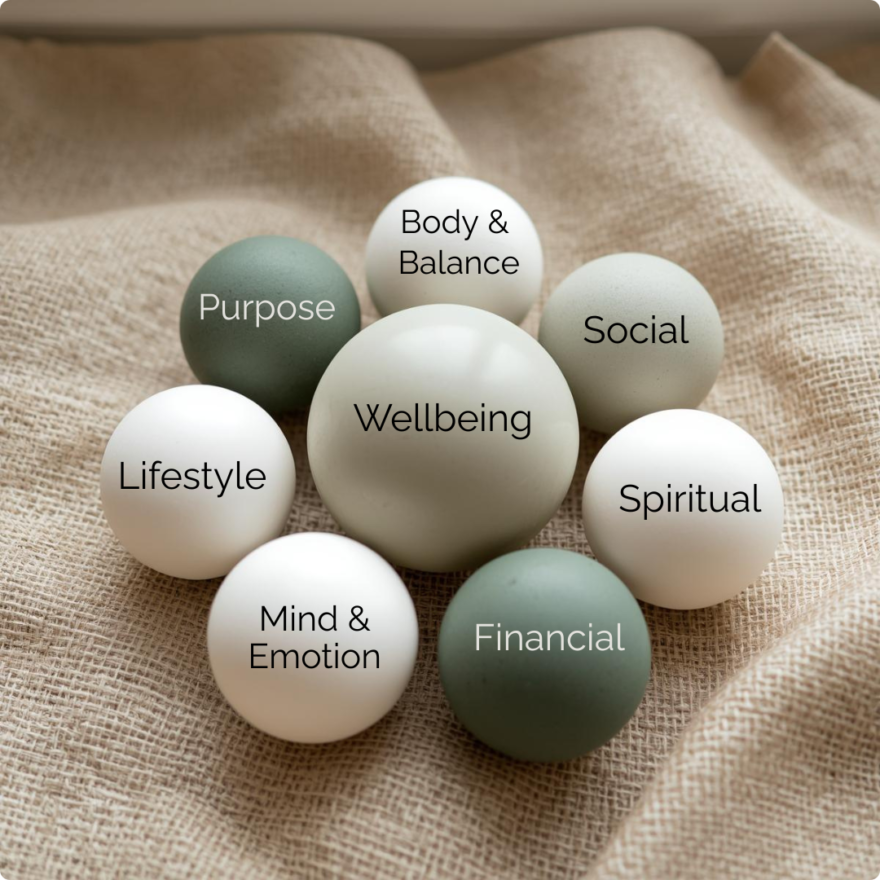
Wellbeing isn’t a single habit, it’s a network of choices that work together.
These seven evidence-based pillars offer a practical path toward balance in body, mind, and spirit.
Start anywhere, they all connect.
Physical Health
A healthy body supports a healthy mind.
-
- Move daily. 150 minutes/week of moderate activity. That’s 21 minutes a day over seven days, or 30 minutes five days a week. You can even break it into 10-minute bursts!
- Eat nutrient-dense, high-fiber, minimally processed foods. Nutrition trumps genetics, that’s real power on your plate.
- Prioritize restorative sleep (7–9 hours). Keep a consistent schedule; your body loves rhythm.
- Stay hydrated and limit alcohol, tobacco, and recreational drugs, they drain your body’s repair systems.
Small, steady choices in movement, meals, and rest create the strongest foundation for every other pillar.
Mental & Emotional Health
Emotional regulation and self-awareness build resilience.
-
- Practice mindfulness or meditation. Start with 1–2 minutes a day no Bali retreat required.
- Build emotional self-awareness. Name what you feel; it strengthens boundaries and relationships.
- Challenge unhelpful thoughts. Reframe with curiosity. Thoughts are habits, and habits can change.
- Seek therapy or counseling when needed. Mental health deserves the same care and attention as physical health.
Thoughts drive feelings. Curious self-awareness, paired with small mental shifts, can transform how you experience life.
Social Connection
Humans are wired for connection. Strong social bonds predict longevity and happiness.
-
- Cultivate supportive friendships. “Platonically date” people, take time to see who fits in your circle.
- Express gratitude and affection, often we feel it but forget to say it.
- Engage in community or volunteer work. Start small, a few hours a month counts.
- Spend tech-free time with loved ones. Face-to-face connection beats a video chat every time.
Connection heals. Choose depth over scroll-time.
Purpose & Meaning
A sense of purpose brings direction and motivation.
-
- Reflect on what truly matters to you. Identify your values and moral compass for decisions.
- Engage in work or hobbies aligned with those values.
- Set meaningful goals. Direction matters more than speed. Nothing worth building is built overnight (except a good salad).
- Pause regularly to recognize your growth. Partial credit counts.
Living on purpose starts with knowing your “why.”
Environment & Lifestyle Balance
Your surroundings influence stress, focus, and energy.
-
- Spend time outdoors. Sunlight and fresh air are underrated therapy.
- Simplify and organize living/work spaces. Does your environment reflect your values?
- Limit noise and digital overstimulation. Use blue-light filters and shut screens off when you can.
- Balance work, rest, and leisure. Seasons of hustle are fine, just make sure they end.
Clean space, clear mind, calm nervous system.
Financial & Occupational Wellbeing
How you earn, spend, and save impacts mental peace.
-
- Create a simple budget. Track where your money goes. A note on your phone works fine.
- Save or invest gradually. Even small, consistent savings can make a big difference over time.
- Align work with your strengths and values. Reassess every few years, comfort can quietly turn to complacency.
- Set boundaries around time and energy. Respect your own resources the way you respect others’.
Financial peace is emotional peace. Awareness is the first step toward freedom.
Spiritual & Existential Health
Connection to something greater fosters peace, perspective, and resilience.
-
- Reflect or journal about meaning and gratitude. Writing helps you notice what’s already good.
- Engage in meditation, prayer, or stillness. Quiet the mind to strengthen the spirit.
- Participate in community or a service aligned with your values. Purpose grows when shared.
- Practice forgiveness and acceptance. Letting go frees you first.
Forgiveness, gratitude, and connection, these are quiet superpowers.
Wit & Wellness™ Takeaway
These pillars are a lot to digest, and that’s okay.
Wellbeing is a journey, not an event. Pick one pillar and take it to the next level.
Reflect, laugh, rest, repeat.
Growth isn’t always graceful, but it’s always worth it.
Evidence Notes
Physical activity
- World Health Organization.
WHO Guidelines on Physical Activity and Sedentary Behaviour.
2020.
Nutrition and chronic disease risk
- Willett W et al.
Food in the Anthropocene: The EAT–Lancet Commission on Healthy Diets from Sustainable Food Systems.
The Lancet, 2019. - Satija A et al.
Plant-Based Dietary Patterns and Incidence of Type 2 Diabetes in US Men and Women.
PLOS Medicine, 2016.
Sleep
- Watson NF et al.
Recommended Amount of Sleep for a Healthy Adult: A Joint Consensus Statement of the American Academy of Sleep Medicine and Sleep Research Society.
Sleep, 2015.
Social connection
- Holt-Lunstad J, Smith TB, Layton JB.
Social Relationships and Mortality Risk: A Meta-analytic Review.
PLOS Medicine, 2010.
Mental health, therapy, and emotional regulation
- American Psychological Association.
Understanding Psychotherapy and How It Works.
APA, 2017. - Gross JJ.
Emotion Regulation: Current Status and Future Prospects.
Psychological Inquiry, 2015.
Stress, environment, and nervous system regulation
- McEwen BS.
Protective and Damaging Effects of Stress Mediators.
New England Journal of Medicine, 1998. - Evans, G. W., & Cohen, S. (2004). Environmental stress. In Encyclopedia of Applied Psychology (Vol. 1). Elsevier.
Purpose and wellbeing
- Alimujiang A et al.
Association Between Life Purpose and Mortality Among US Adults Older Than 50 Years.
JAMA Network Open, 2019.