
Protein has moved from a common nutrient to a cultural celebrity. It shows up in bars, cereal, even coffee. Walk through any grocery aisle and you will see the same promise repeated: more protein, more strength, more control.
Some of that messaging is rooted in truth. Protein does matter. It supports muscle, repair, and satiety. But somewhere along the way, adequacy became obsession.
It is easy to feel behind. Easy to wonder whether you are getting enough, building enough, or optimizing enough.
Protein is not the villain. It is just louder than it needs to be.
So instead of reacting to the volume, let us step back and look at what your body actually requires.
Protein is not the villain. It is just louder than it needs to be.
What Your Body Actually Needs
Protein plays an important role in the body. It provides amino acids that support tissue repair, enzyme production, immune function, and muscle maintenance. It is essential. The question is not whether it matters, but how much is enough.
For most healthy adults, protein needs are modest and predictable. General guidelines suggest roughly 0.8 grams per kilogram of body weight per day for sedentary adults, with slightly higher needs for those who are very active, aging, or recovering from illness. In practical terms, this translates to an amount that most people meet through regular meals without deliberate tracking.

How Much Protein Do Adults Actually Need?
General adult baseline: about 0.8 grams per kilogram of body weight per day
For a 150-pound adult: roughly 55 grams per day
For a 180-pound adult: roughly 65 grams per day
Slightly higher needs may apply with aging, consistent resistance training, or recovery
In otherwise healthy adults with access to food, this amount is typically met through regular meals without deliberate tracking.
Muscle does not grow because protein intake climbs higher and higher. It grows because the body receives a signal to adapt.
Resistance training provides that signal. Protein provides the building materials. Both matter. Neither works in isolation.
Once intake meets your body’s needs, adding more does not accelerate muscle growth. Extra protein does not automatically convert into extra muscle.
Adequacy supports function. Surplus does not multiply benefits. That does not mean protein is unimportant. It means most people are not as behind as they have been led to believe.
Adequacy supports function. Surplus does not multiply benefits.
When More Becomes Less
Protein matters. But when one nutrient becomes the organizing principle of every meal, balance can narrow. When protein takes priority, fiber tends to recede.
Meals built primarily around shakes, bars, or heavily fortified products can crowd out beans, vegetables, whole grains, nuts, and seeds. These foods provide protein, fiber, and phytonutrients. In whole-food form, they work together to support long-term health.
There is also a quieter shift. When meals are evaluated by gram counts alone, internal cues can lose their influence. Tracking has its place, but for many people it gradually replaces hunger, satisfaction, and variety with numerical targets.
Nutrition stops being a pattern and becomes a scoreboard.
The issue is not protein itself. It is proportion. A balanced plate includes adequate protein without asking it to overshadow everything else.
Three Myths Worth Retiring
Myth 1: More Protein Means Better Health
Protein is essential. But once intake meets your body’s needs, adding more does not create additional protection or benefit. Health outcomes are shaped by overall dietary patterns, not by maximizing a single nutrient.
In practice, this can look like choosing a fortified product over a balanced meal simply because the label lists a higher number.
Myth 2: You Cannot Build Muscle Without High Protein
Muscle growth depends first on stimulus. Resistance training signals the body to adapt. Sufficient protein supports that process. More protein does not substitute for training, and beyond adequacy, higher intake does not automatically accelerate results.
It is easy to overestimate intake while underestimating the role of consistent, progressive resistance training.
Myth 3: Plant Proteins Are Incomplete
Individual plant foods vary in amino acid composition. But the body maintains an amino acid pool and draws from it throughout the day. Eating a variety of plant foods across meals provides what is needed. Perfection at each plate is not required.
This concern often leads people to overcomplicate meals that would otherwise be nourishing and sufficient.
What to Focus On Instead
Rather than maximizing a single nutrient, shift your attention to the overall pattern of your meals.
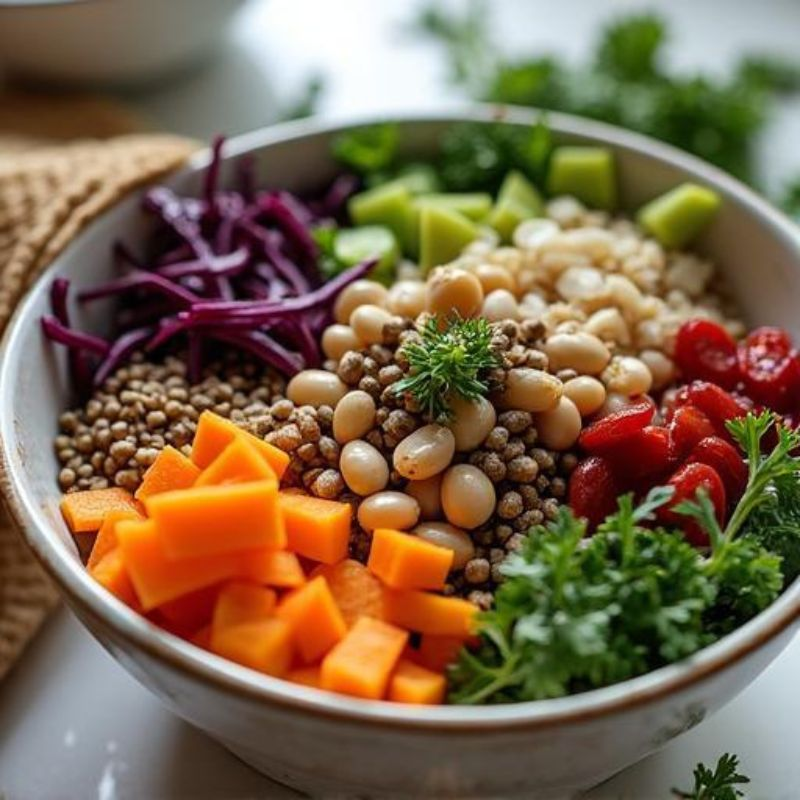
Build plates that are fiber forward. Center beans, lentils, vegetables, whole grains, nuts, seeds, fruits, and intact plant foods. These foods naturally include protein alongside fiber and micronutrients.
Aim for variety. Different foods contribute different strengths. When meals are built around a diverse range of whole foods, adequate protein tends to follow effortlessly.
Start small. Add beans or lentils to one meal this week. Stir them into soup, fold them into a salad, or spoon them alongside what you already eat. A handful of nuts or a sprinkle of seeds can be a simple addition.
Pause before automatically reaching for a “high-protein” version of a product. Consider whether it improves the overall meal, or simply increases a number.
Evidence Notes
National Academies of Sciences, Engineering, and Medicine. Dietary Reference Intakes for Energy, Carbohydrate, Fiber, Fat, Fatty Acids, Cholesterol, Protein, and Amino Acids. Washington, DC: National Academies Press; 2005.
Morton RW, Murphy KT, McKellar SR, et al. A systematic review, meta-analysis and meta-regression of the effect of protein supplementation on resistance training–induced gains in muscle mass and strength. British Journal of Sports Medicine. 2018.
Young VR, Pellett PL. Plant proteins in relation to human protein and amino acid nutrition. American Journal of Clinical Nutrition. 1994.